Feeds:
Posts
Comments

Taqueria Pickles


When I go to our favorite taqueria in town, I look forward to raiding the salsa bar after we pick up our al pastor tacos or carnitas burritos. Although I love the mild green tomatillo salsa, the smokey chipotle salsa, and the brightly colored salsa fresca, I go straight to the escabeche – pickled jalapenos with carrots and onion. They are so hot that one little bite of carrot needs to be chased with a big gulp of horchata, but they are so, so good. So good in fact that we decided to share the love this year by making our own version of “taqueria pickles” to give to our close family and friends for Christmas.

We turned to Alice Waters’ book The Art of Simple Food for guidance. It’s one of my mom’s favorite cookbooks and one that I often borrow because I love the simplicity of her recipes and how they highlight seasonal produce. While dining at Alice Waters’ restaurant Chez Panisse a couple years ago, I ordered a fall fruit bowl for dessert. The waitress presented me with a wooden bowl containing several sweet dates and a couple small seedless tangerines. This humble-looking dish was the perfect way to end a meal and paid tribute to the season. If you haven’t heard of her, Alice (let’s pretend the two of us are on a first name basis) is the pioneer of the “slow food movement,” which celebrates local, sustainable, fresh, and seasonal produce of the best quality. If you can’t make it out to Berkeley, California to eat at her restaurant, you should at least treat yourself to one of her cookbooks. It’s because of her that we pay attention to the little signs at our grocery store that tell us where our produce comes from.

We used Alice’s method for fresh-pickled vegetables, but added a generous amount of sliced jalapeños, as well as whole cumin seeds and coriander seeds to make them more “taqueria-style”. We also decided to can them so they’d last longer. Our taqueria doesn’t add cauliflower to theirs, but we thought it would be delicious – it was! (And since it’s in season, Alice would approve).

I also want to dedicate this post to Dustin’s grandma, who taught us the canning process. We love you and want you to know we’ll continue the annual canning tradition of making your bread & butter pickles, chile sauce, and strawberry jam! <3


“Taqueria Pickles” (Spicy Pickled Jalapeños & Carrots)

(Adapted from Alice Waters’ recipe in her book The Art of Simple Food and the blog Simply Recipes)

jalapeños, thickly sliced
carrots, thickly sliced
red onion, sliced
cauliflower, cut into florets

apple cider vinegar
distilled white vinegar
sugar
bay leaf
coriander seeds
cumin seeds
dried oregano
garlic cloves (un-peeled)
garlic cloves, peeled and halved
salt

  • Wash, trim, and cut your vegetables.
  • For about 3 1/2 cups pickling brine*, combine 1/2 cup apple cider vinegar, 1 cup distilled white vinegar, 1 3/4 cup water, 2 1/2 TBS. sugar, 1/2 a bay leaf, 1/2 tsp. coriander seeds, 1/2 tsp. cumin seeds, pinch of dried oregano, 2 whole garlic cloves, 2 peeled and halved garlic cloves, and a pinch of salt.
  • Bring brine to a boil, then add the vegetables in the order of their cooking time, beginning with the vegetable which will take the longest. Add the carrots first and cook them until they are cooked through but  still a little bit crisp (simply scoop one out to test – about 20 minutes). When you think the carrots have about 10 minutes left to cook, add the jalapeños. Add the sliced onion and the cauliflower florets when you think the carrots are almost done – they will take only a few minutes.
  • If you want to can the pickles – transfer the hot vegetables into mason jars, and fill the tops of the jars with brine. Screw the lids on the jars and process in a hot water bath for 10 minutes. Remove from water and let them sit on the counter until you hear them “pop!” Then you’ll know they’re canned! Once opened, they’ll keep for a couple months in the refrigerator.
  • For refrigerator pickles, allow the vegetables to cool completely after being removed from the brine. Once the vegetables are cool and the pickling brine has cooled to room temperature, divide the vegetables between mason jars (or to another container) and cover with brine. Refrigerated, they will keep for a week. Enjoy with your favorite Mexican dishes.

* When we made our pickling brine, we didn’t measure any of the ingredients, but we kept in mind the ratios from the original recipe. Alice calls for 1 1/2 cups white wine vinegar (which, she says, you can easily sub with red wine vinegar) but we used apple cider vinegar and distilled white vinegar after reading other recipes for pickled jalapeños. We also didn’t use quite as much water as the recipe calls for. When it comes down to it, feel free to tweak things here and there. Taste the brine before you add the vegetables and add more sugar or vinegar or whatever you think it needs. Have fun with your food, and enjoy pickling the bounty of the season.


Salad for dinner may conjure up images of summer evenings, but this one is about as wintry as you can get, and (dare I say) just as comforting as a bowl of soup. Endive cooked in butter becomes nutty and caramelized, pairing perfectly with sautéed apples, baked walnut-encrusted goat cheese, fresh baby spinach leaves, and a sweet-slightly tart pomegranate vinaigrette. We loved the juxtaposition of warm goat cheese, apples, and endive with the cool spinach and the pop of fresh pomegranate seeds. It’s everything you want in a dinner salad, with winter flair. Since we are traveling the day after Christmas to spend time with family, and probably won’t get a chance to post until the new year, we’ll leave you with this festive salad as a way to say Merry Christmas and Happy 2012!! We look forward to the coming year, when we will celebrate our blog’s 5th anniversary (crazy)! There is also a little family venture that’s been brewing that we will reveal soon . Thanks, readers (whoever you are; I love finding out who is actually following along!) What’s your wish for the new year? See you then!


Endive and Apple Salad with Warm Goat Cheese and Pomegranate Vinaigrette

(From the Oct/Nov 2011 issue of Fine Cooking; Serves 4)

1 cup pomegranate juice
6 oz. goat cheese
1/2 cup finely chopped hazelnuts*
3 TBS. butter
2 large Belgian endives, halved lengthwise with core left intact, each half cut lengthwise into 4 pieces
Kosher salt and freshly ground black pepper
2 firm, medium-sweet apples (like Fuji or Honeycrisp), peeled, cored, and cut into 1/2-inch dice (about 3 cups)
1 medium shallot, finely diced (about 3 TBS.)
1 TBS. cider vinegar
1 tsp. Dijon mustard
6 TBS. extra-virgin olive oil
4 oz. (4 lightly packed cups) baby spinach
1/3 cup fresh pomegranate seeds (optional)**
2 Tbs. thinly sliced fresh chives***

* We used walnuts instead.
** Optional, yes, but they look so pretty, don’t they? And they add a refreshing pop to the salad.
*** Our store was out of chives, so I omitted these.

  • Position a rack in the center of an oven and heat to 425°F.
  • In a small saucepan over high heat, reduce the pomegranate juice to about 1/4 cup (it should be syrupy), about 15 minutes (mine took about 12).
  • Meanwhile, mash the goat cheese in a small bowl with a fork until smooth (I must have used a dryer goat cheese because it didn’t mash well. I skipped this step and went straight to forming it into rounds). Form the cheese into four 2-inch-diameter rounds. Put the hazelnuts (or walnuts) on a small plate and press the goat cheese rounds into the nuts on all sides to coat. Transfer the cheese to a small baking sheet and bake until the nuts brown and the cheese softens, 8 to 10 minutes.
  • While the goat cheese bakes, melt 2 TBS. of the butter in a 12-inch heavy-duty skillet over medium-high heat. Arrange the endives flat in the pan (they’ll fit snugly), sprinkle with 1/2 tsp. each salt and pepper, and cook, undisturbed, until browned, 2 to 3 minutes. Flip and cook until the other side starts to soften, 1 to 2 minutes. Transfer to a large plate.
  • Melt the remaining 1 TBS. butter in the skillet, add the apples and shallot, sprinkle with 1/4 tsp. salt and cook, shaking the pan often, until the apples start to soften, 2 to 3 minutes.
  • Transfer the pomegranate juice to a medium bowl. Add the vinegar, mustard, and 1/2 tsp. each salt and pepper; whisk until combined. Gradually whisk in the oil and season with more salt and pepper to taste.
  • In a large bowl, toss the spinach and apples with half of the vinaigrette and season to taste with salt and pepper. Arrange the endives on 4 large serving plates, top  with a mound of the spinach mixture, and then the goat cheese. Sprinkle with the pomegranate seeds and drizzle with the remaining vinaigrette. Serve.


When the December issue of Bon Appetit introduced me to shakshuka, a popular dish in Israel, it screamed comfort to me. You crack eggs over a simmering aromatic tomato sauce, seasoned with paprika, cumin, jalapeño, and garlic, and then transfer the skillet to the oven for them to poach. Chickpeas add substance, crumbled feta adds creaminess, and chopped cilantro adds brightness. Place the hot skillet (carefully) in the middle of the table and dig in with pita bread for dipping. If you succeed in poaching the eggs just right, the whites will be set and the yolks will be nice and runny. I was not so successful. After the suggested 5-8 minutes of cooking time, my whites were still clear, so I let them go a little longer and then they overcooked. Alas. It was still delicious, however, and I’ve been blogging long enough to feel comfortable admitting my screw-up. The next morning I redeemed myself. I fried two eggs (perfectly over easy, I might add – I’m more comfortable cooking eggs in a pan than in the oven) and placed them over the leftover tomato sauce/chickpea/feta mixture. Amazing. There are not many meals that I’d gladly eat for breakfast, lunch or dinner, but this is one of them.

The holidays can be a time of stress, whether it’s menu planning for your first Christmas dinner, braving the crowds downtown to find the perfect sweater for uncle so-and-so, or entertaining last minute out-of-town guests. Or in my case, maybe you have a 20 month old who can go from being the sweetest boy in the world to screaming at the top of his lungs when Mommy decides it’s time to leave the children’s section of the bookstore to pay for our books. In the midst of this kind of week, may I suggest this meal as a quick (and more importantly, comforting) weeknight dinner. In 30 minutes it can be on your table, and as soon as you tear off that first piece of pita and dip it into the bubbling sauce, you’ll be reminded of what matters. There is good food to be had. And look at the people sitting around your dinner table – you’re truly lucky to have them. Looking at my own (grown-up) baby reminds me of that baby in a manger, oh so long ago, who embodied love and grace for the world; I don’t know about you, but I could sure use some of that right about now.


Poached Eggs in Tomato Sauce with Chickpeas and Feta

(From the December 2011 issue of Bon Appetit)

1/4 cup olive oil
1 medium onion, finely chopped
4 garlic cloves, coarsely chopped
2 jalapeños, seeded, finely chopped
1 15-ounce can chickpeas, drained
2 teaspoons Hungarian sweet paprika
1 teaspoon ground cumin
1 28-ounce can whole peeled tomatoes, crushed by hand, juices reserved*
Kosher salt and freshly ground black pepper
1 cup coarsely crumbled feta
8 large eggs**
1 tablespoon chopped flat-leaf parsley
1 tablespoon chopped fresh cilantro
Warm pita bread

*I used one 15 oz. can of whole peeled tomatoes, and one 15 oz. can of Muir Glen fire roasted tomatoes (had to make use of what was in my pantry).

**For the 3 of us (yes, Levi actually counts as a whole person now when it comes to serving sizes), I used 5 eggs. I kept the amount of tomato sauce the same, even though the original recipes says it serves 4-6. It makes wonderful leftovers, and you can always fry an egg (or 2) the next morning and place it on top of the sauce.

  • Preheat oven to 425°. Heat oil in a large oven-proof skillet over medium-high heat. Add onion, garlic, and jalapeños; cook, stirring occasionally, until onion is soft, about 8 minutes. Add chickpeas, paprika, and cumin and cook for 2 minutes longer.
  • Add crushed tomatoes and their juices. Bring to a boil, reduce heat to medium-low, and simmer, stirring occasionally, until sauce thickens slightly, about 15 minutes. Season to taste with salt and pepper. Sprinkle feta evenly over sauce. Crack eggs one at a time and place over sauce, spacing evenly apart. Transfer skillet to oven and bake until whites are just set but yolks are still runny, 5–8 minutes. Garnish with parsley and cilantro. Serve with pita for dipping..


Take-out was a temping last minute dinner option, but instead I found myself searching the freezer for something that I could turn into a suitable meal. We had planned to eat dinner at my parents’ house, but a wind storm ripped through Santa Cruz that day/evening, knocking out power to many, and even bringing trees down on top of houses. Luckily, the latter did not happen to my parents’ house, but no power and a tree blocking their road meant a definite plan B.


Back to the freezer search. The first thing that caught my eye was puff pastry, an impulse purchase I had made last week. How fortuitous! I decided I wanted to make some sort of puff pastry tart or “pizza.” Now, what to top it with … ah! Half a butternut squash, peeled and cubed that I froze last week. This would do. I added some fresh rosemary from the garden, caramelized our last onion, and cut up some coppa (one of our favorite charcuterie offerings from El Salchichero) to add a little salty kick. This rustic puff pastry tart was a success. Feel free to adapt this for whatever needs to get used in your freezer on a stormy evening. It would also make a lovely appetizer when cut into squares.

Butternut Squash, Caramelized Onion & Rosemary Tart

(Adapted from A Cozy Kitchen)

1 yellow onion, sliced
Extra virgin olive oil
Butter
1 cup cubed butternut squash
Flour, for dusting work surface
1 sheet frozen puff pastry
1/4 cup coppa, diced (can also use salami, or cooked, crumbled bacon or pancetta)
Pecorino Romano cheese, grated (enough for sprinkling on top)
Mozzarella cheese, shredded (about 3 ounces)
Fresh rosemary, chopped
Salt and pepper

  • Preheat oven to 450 degrees.
  • In a medium skillet, heat olive oil and a little pad of butter over medium high heat. Once oil is hot, add sliced onions and pinch of salt. Cook until caramelized, about 25-30 minutes, stirring frequently. When onions are a beautiful light golden brown color, add a splash of balsamic vinegar. Stir to coat the onions, then remove from heat.
  • While onions are caramelizing, place cubed butternut squash (if frozen, defrosted first) on a parchment lined baking sheet and roast for 15-20 minutes, or until tender with a fork, stirring halfway through. Turn oven heat down to 400 degrees.
  • On a floured surface, roll the puff pastry into a rectangle (or square – whatever – it’s a rustic tart!) Carefully transfer puff pastry onto a parchment lined baking sheet. Using a sharp knife, lightly “score” the pastry dough, 1-inch in from the edges. Then using a fork, poke holes inside the markings. This will ensure that the outside trim puffs up and the middle stays flat. Bake for 15 minutes, or until slightly golden brown.
  • Scatter mozzarella cheese and some the Pecorino Romano over the puff pastry. Next, top with the roasted butternut squash, caramelized onions, rosemary, and sliced coppa. Finish with a little more pecorino. Sprinkle with salt & pepper.
  • Return to oven and bake for 15 minutes more, or until cheese is melted and edges are golden brown. Slice and serve.


This Thanksgiving we survived an 8 hour car ride with a toddler down to San Diego, where Levi had his first zoo experience. He was excited about every animal he encountered but was especially enamored by the elephants. Once Levi was tuckered out, we headed back to my mother-in-law’s house, where we watched plenty of football, drank plenty of San Diego micro-brews, and had quite a feast: a turkey breast roulade stuffed with brandied fig & cranberry stuffing, gravy, sweet potato gratin, and sautéed brussels sprouts with pancetta, shallot, mushrooms, and balsamic (which actually converted one member of the family who was a self-professed brussels sprouts hater. I was so proud). For dessert we indulged in a vanilla bean cake with salted caramel frosting. It was a wonderful evening and we went to bed feeling thankful for family and the way in which good food and drink bring us together.


As we’re entering the Christmas season and there’s a definite chill in the air, I’ve been allowing the oven to do most of the cooking in the evening, which frees us to relax and focus on the things that are important, like playing with our ever-changing, ever-moving 19 month old.

Spinach-artichoke dip is one of my favorite appetizers to bring to parties, so I associate it with festive gatherings. We were pleased to bring that spirit of festivity into a weeknight dinner. Portobello mushroom caps are filled with a spinach-artichoke filling and then topped with seasoned panko breadcrumbs. The end result is nothing short of comforting – the perfect hybrid of stuffed mushrooms and spinach-artichoke dip. For a side dish, I roasted some cubed butternut squash with olive oil, thyme, and sage. Even Levi could not resist their caramelized edges. A salad of mixed greens with apple & pomegranate seeds completed the meal.

We wish you many comforting meals during this season of Advent (break out the good wine!) with the people you love, enjoying every last bite.


Portobello Mushrooms with Creamy Spinach-Artichoke Filling

(From the Dec 11/Jan 12 issue of Fine Cooking)

3 TBS. olive oil 
3 medium cloves garlic, minced (1 TBS.) 
4 medium portabello mushrooms, stemmed, gills removed*
Kosher salt
Freshly ground black pepper
4 oz. cream cheese, softened
3 TBS. mayonnaise  
1-1/2 tsp. fresh thyme
9 to 10 oz. frozen chopped spinach, thawed and squeezed dry**
9 oz. frozen artichokes, thawed, lightly squeezed dry, and chopped*** 
1/2 cup panko breadcrumbs
1/3 cup finely grated Romano cheese

* Fine Cooking recommended using a butter knife – it worked great!
** I used fresh baby spinach, sautéed, squeezed, and roughly chopped
*** I used marinated artichokes for more flavor, drained and roughly chopped

  • Position a rack in the center of the oven and heat the oven to 450°F.
  • In a small bowl, combine 2 TBS. of the oil and about two-thirds of the minced garlic. Brush the insides of the mushroom caps with the garlic oil and sprinkle generously with salt and pepper. Arrange the mushrooms oiled side up on a rimmed baking sheet and roast until just tender, about 10 minutes.
  • Meanwhile, in a medium bowl, mix the cream cheese, mayonnaise, and 1/2 tsp. of the thyme with the back of a wooden spoon. Stir in the spinach and artichokes and season to taste with salt and pepper. In another medium bowl, combine the remaining garlic, 1 TBS. oil, and 1 tsp.  thyme with the breadcrumbs and cheese.
  • Spoon the artichoke mixture evenly into the mushroom caps and sprinkle with the breadcrumb mixture. Bake until the crumbs are golden-brown and the filling is hot, about 10 minutes. Serve immediately.

Olive Oil Pumpkin Bread


Coming from someone whose favorite season is fall and whose birthday falls on Thanksgiving once in a while, it might sound surprising that I am not a huge fan of pumpkin pie. Instead, you’ll find me gravitating towards the pecan or chocolate cream pie on our dessert table. I do love pumpkin; I guess I’m just particular about texture and the way in which it’s prepared. One of my favorite ways to enjoy it this time of year is simply roasted in the oven with butter, cinnamon, and cardamom (like these little roasted pumpkins). And as far as pumpkin desserts go, I adore pumpkin ice cream, pumpkin bread pudding, and pumpkin bread/muffins.

There are so many recipes out there for pumpkin bread that a quick google search left me feeling overwhelmed. I decided to flip through my neglected fall issue of Fine Cooking and was drawn to this pumpkin bread recipe because it uses olive oil instead of butter (which not only provides antioxidants, but justifies slathering each slice with butter before eating), honey is added for sweetness, and the top of the loaf is studded with pumpkin seeds. It sounded perfect, and since Levi was in the middle of one of his 3-hour marathon naps (which are few and far between), I decided to jump on the opportunity to bake!

The result was a pumpkin bread with a hint of nutty flavor and subtle kiss of honey, which really comes out the next day when you toast a slice in the toaster oven. The pumpkin seeds also add the perfect crunch. I found myself saving the top of my bread slice for last because of those tasty little seeds. The recipe says they’re optional, but I’d recommend adding them because it’s one of the things that sets this pumpkin bread apart from the rest.


Olive Oil Pumpkin Bread

(From the Oct/Nov 2011 issue of Fine Cooking; by Ellie Krieger)

cooking spray (or butter for greasing)
3-1/4 oz. (3/4 cup) whole wheat flour
3 oz. (2/3 cup) unbleached all-purpose flour
1 tsp. ground cinnamon
1 tsp. baking soda
1/2 tsp. baking powder
1/2 tsp. ground nutmeg
1/4 tsp. table salt
2 large eggs
1 cup canned pumpkin purée
1/2 cup packed light brown sugar
1/3 cup olive oil
1/3 cup honey
2 TBS. unsalted pumpkin seeds (also called pepitas)

  • Preheat oven to 350°F and position rack to the center of oven. Spray a 9×5-inch loaf pan with cooking spray (or grease with butter, as I did).
  • In a medium bowl, whisk together both flours, cinnamon, baking soda, baking powder, nutmeg, and salt.
  • In a large bowl, whisk together the eggs, pumpkin, sugar, oil, and honey until well combined.
  • Add the dry ingredients to the wet ingredients, and stir with a large spoon just until evenly incorporated.
  • Spoon the batter into the prepared pan and smooth the top. Tap the pan on the counter a few times to settle the batter. Sprinkle the top with the pumpkin seeds, pressing them down lightly. Bake until the top is browned and a wooden skewer inserted in the center comes out clean, 40 to 45 minutes (mine took a little longer – about 1 hour – but it was a rainy day so perhaps the humidity had something to do ith it? Who knows). If the bread begins to brown too much before it’s fully baked, lay a piece of aluminum foil on top.
  • Cool in the pan for 15 minutes and then transfer the bread to a rack to cool completely before slicing. Serve with butter, because you deserve it :)


Green bean casserole never made an appearance on our Thanksgiving table when I was growing up. It was as foreign to me as cranberry sauce out of a can. One night when I was in college (because I was curious what the fuss was all about), my roommate and I made green bean casserole, following the recipe on the french fried onions can. It tasted pretty good – but what doesn’t taste good when you’re a college student, you’re hungry, it’s late at night, and you need an excuse to take a break from studying macro-economics (which I never passed, sadly, but that’s a whole different story). Anyway, we thought that the best part of the casserole was the french fried onions on top, but other than that, it was nothing to write home about …


… until today, when I find myself writing about green bean casserole because it’s recipe swap time again.  The theme was Thanksgiving side dishes, and I just so happened to get a variation of green bean casserole from Nichole of The Cookaholic Wife! I did something a little different this time with the swap. Instead of following the recipe to a T, I was inspired by the recipe I was given, particularly the introduction where Nichole shared that she isn’t a huge fan of cream of mushroom soup in a green bean casserole, but might consider adding fresh mushrooms instead. What a great idea! Especially since we’re at the peak of wild mushroom season. I love the orange-y hue of chanterelles, as well as their earthy, umami flavor, and knew they would be the perfect thing to add to this casserole.


Instead of using regular green beans, we had these beautiful romano beans from a local farm that inspired me to take the casserole in a slightly different direction. These beans, a far cry from the canned or frozen beans that often end up in a casserole, didn’t want to compete with a {albeit delicious} mass of cheese. So, instead of using the cheddar & provolone in the original recipe, I decided that a sprinkling of grated Pecorino Romano cheese was a nice modest addition to the casserole, adding a little cheesy taste without making the dish too heavy, and allowing the green beans to really shine through in all their local, organic glory. And the french fried onions? Well, of course we had to keep those. How often do you have a good excuse to buy a can of french fried onions (unless you’re in college)? The crunchy, golden brown topping is a nod to the traditional casserole, while what’s underneath celebrates the bounty of the season.


I didn’t really measure anything while making this casserole, but wrote the recipe in such a way that you can easily adapt it, depending on how many green beans and chanterelles you have.


Green Bean Casserole, Revamped

(Adapted and inspired by The Cookaholic Wife)

Romano Beans (or regular green beans), washed, trimmed, and cut into bite-sized pieces
Chanterelle Mushrooms, cleaned and sliced
minced garlic
dry white wine or sherry
heavy cream
fresh rosemary, chopped
fresh sage, chopped
salt & pepper to taste
Pecorino Romao cheese, grated
French fried onions

  • Blanch the cut green beans in boiling water for several minutes (romano beans are longer and wider than regular green beans so will take longer), until almost tender. Drain and set aside.
  • Add some butter and a drizzle of olive oil to a pan over medium-high heat. When the butter foams, add the sliced chanterelle mushrooms and cook, stirring occasionally, until beginning to turn golden-brown and the mushroom liquid (if any) has evaporated, about 5-7 minutes. Add the garlic and cook for 1 minute more. Add a couple splashes of white wine (or sherry) and cook, stirring, until it evaporates. Add a good amount of cream to the mushrooms and cook, stirring, until it has reduced slightly and has nicely coated the mushrooms. Stir in fresh sage and rosemary. Taste and season with salt and pepper.
  • Add the blanched beans to the pan with the mushrooms and stir so that the beans are evenly coated with the cream sauce. Pour everything into a baking pan. Top with a thin layer of grated Pecorino Romano cheese, and then a nice generous layer of french fried onions. Bake in a 350 degree oven for about 20 minutes or until heated through and top is golden brown. Cover with foil for the last 10 minutes of baking if the top is browning too quickly.

Beef & Green Chile Chili


October in Santa Cruz: 70-80 degree weather engages in a battle with the coastal fog. Usually they settle this amicably and agree to take turns. In terms of dinner (because it’s all about the food), this means a week of barbecues followed by a week of chili and soup, or “earthquake weather,” as we call it, after the big quake of ’89.

On the evening of October 17th, the warmth had defeated the fog. It was 5:04 pm, and as my mom, brother (age 2 1/2), and I (age 5) were eating pasta with pesto, the house began to shake with a violent rumble, and everything in my vision became a blur.  I remember running to the door frame as my mom got my brother out of his high chair, and we heard glasses and dishes breaking in the kitchen. It seemed to last forever. My glass of milk that had accompanied the pesto pasta made its way out to the front yard with the rest of us, where it sat precariously on a white patio table. I remember trying to drink it an hour after the quake, but it tasted warm and wasn’t very appealing. To this day, whenever I taste milk that’s slightly warmer than fridge temp, I think “Earthquake!”

Here we find ourselves enjoying another warm week in October, 22 years later (I just dated myself) and we just so happened to have two small earthquakes in the Bay Area yesterday. I told you it’s earthquake weather! Even though weeks like this cry out for burgers and hot dogs, we crave chili, a symbol of the season, and we love the comfort that it brings, knowing that it’s only a matter of time before the fog returns.

You know what else brings comfort? A post-chili walk on the beach on one of those warm evenings, paired with a magnificent sunset. Moments like these make living on a fault line worth it.


This was the first bean-less chili recipe we’ve ever made, but now I understand why this type of chili is popular in Texas. Hearty ground beef and green chiles are the stars of this chili, which is seasoned with a homemade chili powder and thickened with pureed fried corn tortillas. Unfortunately, we couldn’t get our hands on Hatch chiles, the kind that chef Tim Love recommends, but we used Anaheim instead, one of the recommended substitutions.

Still looking for a chili recipe for Halloween? This might have to be the one. Who knows if it will be chilly or balmy; earthquake or no earthquake. Either way, October calls for chili. It’s not the prettiest dish in the world, but we thought that some minced jalapeño and crispy fried corn tortilla strips added some aesthetic appeal. You can make this chili up to 4 days ahead of time – store it in an airtight container in the refrigerator and gently reheat before serving. Serves 6.


Beef & Green Chile Chili

(From the Oct/Nov 2011 issue of Fine Cooking; by Tim Love)

For the Spice Mixture:

2 dried guajillo chiles
1-1/2 TBS. ground cumin
1 TBS. freshly ground black pepper
1 TBS. granulated sugar
2-1/2 tsp. dried oregano
1-1/2 tsp. dried thyme
1 tsp. kosher salt
3/8 tsp. ground nutmeg

For the Chili:

8 large fresh Hatch chiles (or Anaheim or Cubanelle chiles)
1-1/2 lb. 85%- to 90%-lean ground beef
1/2 cup vegetable oil
2 6-inch fresh corn tortillas, quartered
2 medium yellow onions, finely chopped
1 large green bell pepper, halved, cored, and coarsely chopped
2 to 3 medium jalapeños, finely chopped
2 small cloves garlic, minced
3 TBS. all-purpose flour
5 cups lower-salt chicken broth, heated
Kosher salt

  • Make the spice mixture – Stem, seed, and grind the chiles to a powder (we used a coffee grinder); you should have about 1 TBS. In a medium bowl, combine the chile powder with the remaining spice mixture ingredients.
  • Position an oven rack about 4 inches from the broiler and heat the broiler on high. Place the chiles on a large, heavy-duty rimmed baking sheet and broil, turning with tongs as needed, until charred on all sides, about 10 minutes total. Transfer the chiles to a large bowl, cover with plastic wrap, and set aside until cool enough to handle. With gloved hands, peel, seed, and finely chop the chiles; set aside.
  • Put the ground beef in a large bowl. Mix in 3 TBS. of the spice mixture.
  • Line a plate with paper towels. Heat the oil in a 5- to 6-quart heavy-duty pot over high heat. Add the beef and cook, stirring often, until browned, 4 to 5 minutes. Use a slotted spoon to transfer the beef to a medium bowl and set aside.
  • Put the tortillas in the hot oil and fry on both sides, turning occasionally with tongs, until golden-brown and crisp, 3 to 5 minutes. Transfer the tortillas to the paper-towel-lined plate and set aside.
  • Reduce the heat to medium. Add 1 1/2 cups of the onions and the remaining spice mixture to the pot. Cook for 15 seconds, constantly stirring and scraping the bottom of the pan. Add 1/2 cup of the roasted chiles, half of the bell peppers, and half the jalapeños. Cook the mixture, stirring frequently, until the green peppers are softened, about 8 minutes. Stir in the garlic and cook, stirring, for 30 seconds.
  • Stir the flour into the vegetable mixture and cook for 2 minutes, stirring constantly and scraping any browned bits from the bottom of the pan. Add 1 cup of the broth, stirring and scraping the bottom of the pan until no lumps remain. Add the remaining 4 cups of broth and 1 TBS. salt. Stir and bring to a boil.
  • While the mixture comes to a boil, transfer 1 cup of the broth mixture to a food processor. Crumble in the fried tortillas and process until the tortillas are finely chopped. Pour the tortilla-broth mixture back into the pot and stir in the remaining onions, bell peppers, and the meat.
  • Return the mixture to a boil, reduce the heat to medium low to low and simmer, stirring occasionally and skimming the surface as needed, until the chili is thick, about 50 minutes.
  • Stir in the remaining roasted chiles and jalapeños and simmer, stirring occasionally, for 15 minutes. Skim off any oil that rises to the surface. Season to taste with salt. Garnish with crispy fried corn tortilla strips and minced jalapeno to taste, and serve warm corn tortillas on the side.

Skillet Cornbread

It took us six years of marriage to acquire our first cast iron skillet. I’m not sure of the reason behind this huge oversight, but we can finally put it behind us. When we brought our seasoned skillet home, the first thing I wanted to make in it was my mom’s cornbread. I say “my mom’s” because it’s the recipe she always made when I was growing up, but originally it’s from Joy of Cooking. My brother and I always looked forward to eating this cornbread with dinner (usually chili or some kind of soup) because of the honey bear that always made its way onto the table. The cornbread itself isn’t too sweet, and it has a nice tang from the buttermilk, so it’s the perfect match for honey! I always cut my slice of cornbread in half, providing more surface area for butter and honey, of course!


Now that pumpkins are appearing on doorsteps, pumpkin ales are on store shelves, and chili is making a frequent appearance on dinner tables,  it’s safe to say that fall has come, making this the perfect time to share this cornbread recipe with you. It will go wonderfully with your family’s favorite chili recipe. Just don’t forget the honey bear.


Skillet Cornbread

(From Joy of Cooking)

1 cup flour
1/2 tsp. baking soda
1 1/2 tsp. baking powder
1-2 TBS. sugar (I usually add a second tablespoon because Dustin loves a somewhat sweeter cornbread)
1/2 tsp. salt
3/4 cup cornmeal (I use medium grind)
1 1/2 cups buttermilk, plain yogurt, or sour cream (or in a pinch, a combination of any of those things)
2 eggs
4 TBS. butter, melted (you can also use olive oil, which results in a different taste and slightly different texture, but also good!)

  • Preheat oven to 425 degrees. Grease a cast iron skillet (the best option for a yummy, crispy crust, but you can also use a glass baking pan).
  • Sift together the flour, baking soda, baking powder, sugar, salt, and cornmeal.
  • Beat together the buttermilk (or yogurt or sour cream), eggs, and melted butter.
  • Place your greased skillet or baking pan into the oven to preheat while you mix the batter.
  • Stir the liquid ingredients into the dry ingredients with a few swift strokes (aka don’t mix it to death).
  • Pour the batter into the preheated greased pan. Bake about 25 to 30 minutes or until a toothpick inserted into the middle of the cornbread comes out clean and the top is started to turn golden. Serve slices of cornbread with butter and honey, alongside your favorite soup or chili!

Curried Sweet Potato Hash


Writer’s block. Why me?  On a good day I can write three paragraphs about something as simple as a grilled cheese sandwich. On others, like today, I feel like I can’t even do justice to the 6th Anniversary meal that we enjoyed at Casablanca this past weekend, other than it was delicious / exquisite / flavorful / [enter your favorite food adjective here].


I can tell you that ocean views, micro-brews, crispy calamari, and baked mac ‘n triple cheese were involved, and that as we consumed these things, we looked out onto the very beach where we took our wedding pictures and said “I do.” And I’m not sure which was better – the strawberries and honeyed ricotta sandwiched between two delicate, buttery house-made shortbread cookies paired with a local pinot noir? Or the opportunity to eat out as a couple, minus the high chair? Let’s just call it a tie.


Since I just confessed my recent lack of words, it’s a good thing that this curried sweet potato hash doesn’t need a verbose description. Hash isn’t a particularly glamorous dish, but it’s easy and comforting, which is what I’ve been needing lately. Cubed potatoes and sweet potatoes are the base, to which you add a colorful melange of chopped red peppers, onions, mushrooms, and spinach. The curry powder/heavy cream/Worcestershire mixture that you pour over the vegetables adds that “mmm, what’s in this?” element  to the final product, and elevates the hash from its usual place on a breakfast or brunch menu to what I deem a suitable weeknight dinner.

The original recipe includes leftover cooked chicken or turkey, but I wanted to make  a vegetarian hash for a “meatless Monday” so I increased the amount of potatoes. If you want to try the turkey or chicken version, reduce the amount of potatoes to 1 1/2 cups and add 2 cups cubed, cooked turkey or chicken. I’m definitely going to be making this again after Thanksgiving! I served our hash with skillet cornbread, a salad, and of course a couple glasses of wine. Cheers to the simple meals today, memories of extravagant meals in the past, and hopefully more eloquent descriptions of meals in the future.


Curried Sweet Potato Hash

(Slightly adapted from “Cozy Turkey Hash” in The New Basics Cookbook)

3 cups cubed, cooked potato (a mixture of white and sweet)
1/4 cup chopped onions
1/4 cup chopped red bell pepper
1/4 cup chopped mushrooms
2 big handfuls baby spinach, roughly chopped
3 TBS. chopped fresh parsley
5 TBS. heavy cream
1 egg, lightly beaten
2 garlic cloves, minced
1 tsp. Worcestershire sauce
1 tsp. curry powder
1/2 tsp. paprika
1/2 tsp. salt
freshly ground black pepper, to taste
1 TBS. vegetable oil + 1 TBS. butter

  • Preheat the broiler.
  • Combine the  potatoes, onion, bell pepper, mushrooms, spinach and parsley in a large bowl. Toss well.
  • In another bowl, stir together the cream, egg, garlic, Worcestershire, curry powder, paprika, salt, and pepper.
  • Stir the cream mixture into the potato mixture and let stand for 30 minutes, stirring occasionally.
  • Heat the oil and butter in a 10-inch oven-proof nonstick skillet over medium heat. Add the potato mixture, cover, and cook until the bottom is set, about 5 minutes.
  • Transfer the skillet to the broiler and broil until the top is set and golden, 5 minutes. Serve immediately. Makes 2-3 servings.

Buffalo Chicken Rolls


I love the foods that are associated with football, but I’m not a huge football watcher. I do, however, remember hanging out in the living room with my uncle and grandpa the weekend before Thanksgiving, while they watched “the big game” – Cal versus Standford. I learned how to shout “Go Bears!” with much enthusiasm. I probably learned how to shout some other phrases too that weren’t quite as wholesome. Since those days, I find the background noise of a football game on TV oddly comforting, even though I don’t really have a desire to sit down and watch a game from start to finish.

When I found out that the theme of this Recipe Swap was Tailgating/Appetizers, I still wanted to participate, despite my lack of tailgating experience. I happen to know that delicious foods are present while watching football, things involving melted cheese, fried goodies, and perhaps buffalo sauce. Yes, please. Not every day, but it’s fun to indulge once in a while, whether or not you’re watching football. Grilled Sriracha “Poppers” were our contribution to the swap; Buffalo Chicken Rolls were assigned to me.


These rolls are everything you love about buffalo wings, wrapped up neatly in an egg roll wrapper and baked until crispy and golden. When you bite into them, you get a combination of spicy buffalo chicken and cooling blue cheese crumbles. We agreed that the shredded cabbage and carrots were overpowered by the strong flavors of the buffalo chicken and blue cheese and didn’t add much, but I definitely understand wanting to add something fresh to the rolls. If we made these again, we’d probably just serve the traditional celery and carrots and blue cheese dip next to the buffalo chicken rolls, or maybe a slaw.

Also, while we appreciated the ease (and possible health benefits) of baking instead of frying, we think these would have been even better if they had been pan-fried in oil or deep-fried so that all surfaces of the egg roll wrappers could have gotten crispy; We found some of the edges to be a little undercooked when they came out of the oven. But putting these minor things aside, this is a fun appetizer with bold flavors that are sure to please the crowds, whether you’re tailgating, entertaining your friends, or just looking for something fun for dinner.


Buffalo Chicken Rolls

(Slightly adapted from Taste and See; originally from Can you Stay for Dinner?)

5 TBS. butter
3/4 cup Crystal Hot Sauce (or your preferred hot sauce)
1/8 teaspoon garlic powder
2 cups chicken, shredded (we bought a rotisserie chicken and shredded it ourselves)
1/2 cup (2 ounces) crumbled blue cheese
1/2 a head of Napa cabbage, shredded, tossed with 1/2 of a medium carrot, grated*
12-15 egg roll wrappers
Small bowl of water
Vegetable or Canola oil
Blue cheese dressing or Ranch dressing for dipping

*The original recipe calls for a bag of cole slaw mix, something we’ve never bought (and come to think of it, have never noticed at our natural foods store), so we decided to buy fresh cabbage and shred it ourselves instead. I added some grated carrot too.

  • Melt the butter in a medium sauce pan over low heat, stirring until completely melted. Add the hot sauce and the garlic powder. Stir to incorporate. Add the sauce to the shredded chicken. If you want less heat, use less sauce, but we pretty much used it all! Mix until the chicken is moistened with the sauce.
  • Preheat oven to 400-degrees F. Lay egg roll wrappers on a clean work surface. Begin by placing one tablespoon of the shredded cabbage/carrot mixture on the diagonal of the bottom right corner of one of the wrappers. Next, place 2 tablespoons of shredded buffalo chicken evenly on top of the slaw. Sprinkle some blue cheese crumbles over the chicken. Do not overfill.
  • To fold: Fold the bottom right corner over the stuffing mixture so that it covers it completely, with the tip of the corner now pointing to the center of the egg roll wrapper. Fold in the bottom left corner, followed by the right, so that you now have formed an envelope. Roll the wrap upward one time, leaving the top left corner open. Wet your index finger in the small bowl of water and press to moisten the top left corner. Now fold that down on top of the filled roll, sealing it like you would an envelope.

(Unfortunately, I didn’t take a picture of the assembly process – if you’re a visual person like me and need some great photos to see how to do this, check out the original recipe here).

  • Repeat with remaining rolls.
  • Place the rolls on a greased wire rack set on top of a cookie sheet. Brush the rolls lightly with oil or spritz with cooking spray. Bake for 10-12 minutes or until rolls are golden brown, flipping the rolls halfway through. Allow to cool for several minutes before serving with blue cheese or ranch for dipping.


My son is obsessed with the garage. It’s no surprise. His father and his grandfather (my dad) love it as well. It’s where they spend many a Saturday, working on projects of various sorts. The other evening as we were getting ready to start dinner, Levi made his usual “uh? uh?” sound while pointing emphatically towards the garage. There’s no ignoring that request. Once inside, we turned our backs for 20 seconds while we opened the garage door and got out the BBQ in anticipation of grilling some pork tenderloin, and he had climbed about 6 rungs of the extension ladder that’s propped up agained the wall. Parenting fail. When we got him safely on the ground,  he pointed to the BBQ and blew three times (the indication of it being hot). “You’re right,” I say, “It’s not hot yet, but it will be soon. We’re going to grill some pork tenderloin tonight! Are you hungry?” (Oh, and by the way, never do that again. You scared the sh!t out of me).


A jar of apricot jam in the pantry inspired this pork tenderloin, which came from El Salchichero, our community butcher. We decided to make a sweet and spicy glaze by combining the jam with some minced rocoto pepper from our backyard. These peppers are spicy – almost like a habanero – so we used them sparingly. Some fresh Meyer lemon juice added a little acidity to balance things out.


When the coals were hot and the tenderloin had been marinating in a little olive oil, rosemary, salt and pepper, I asked Levi to get the  BBQ tongs and bring them to daddy. Not surprisingly, he knows where they’re located and is always eager to help if it means retrieving something from the garage. After grilling, we allowed the pork tenderloin to rest so that it would be nice and moist when we sliced into it. The glaze caramelized nicely on the outside and imparted a subtle sweet and spicy flavor. Not bad for a quick weeknight meal. Levi enjoyed it too. Climbing an extension ladder makes for a good appetite.


Pork Tenderloin with Spicy Apricot Glaze

1 pork tenderloin (about 1 lb.)
extra virgin olive oil
kosher salt
freshly ground black pepper
fresh rosemary, chopped
apricot jam (about 1/2 cup – I used 1/2 of a 9.5 oz. jar)
1/2 a hot chili pepper (such as a jalapeño, serrano, or rocoto), minced
fresh lemon juice (I used 1/2 of a fairly large Meyer lemon)

  • Place the tenderloin in a baking dish (or on a big plate) and drizzle a little olive oil over it. Season with salt, pepper, and rosemary. Using your hands, rub the oil and seasonings all over the tenderloin. Cover and refrigerate.
  • Meanwhile, in a small bowl, combine the apricot jam with the minced hot pepper, lemon juice, and some salt & pepper. Mix well. Taste and add more ingredients as necessary to balance the flavors. I ended up adding a little more lemon juice and more peppers after tasting.
  • Take the tenderloin out of the refrigerator as you prepare a charcoal grill. When coals are ready, brush the apricot glaze on the tenderloin so that it covers all surfaces. Place on the grill, cover, and cook for about 4 minutes. Brush more glaze on the top, flip the tenderloin, and glaze the other side as well. Cover and cook for another 3-4 minutes. Continue glazing and flipping every few minutes, until the inside of the tenderloin reaches an internal temperature of 160 degrees and the outside is nicely caramelized. Transfer to a cutting board and allow to rest for several minutes. Slice and serve with your starch and vegetable of choice. We had couscous, grilled summer squash, and a salad.

Gyoza


Thank goodness for gyoza. It sustained us for a couple evenings during that first week in Japan when we were still jet-lagged, everything felt so foreign, and we hadn’t yet learned how to navigate our supermarket across the street. When we got up the courage to walk in, we were bombarded with bright florescent lights, foreign sounds, and (hallelujah) the prepared foods section, where we were immediately drawn to something familiar – plastic packages containing 6 perfectly browned gyoza, with a packet of dipping sauce on the side. We threw several packages into our basket, fumbled our way through the check-out line, and made it home. We heated them up in a pan (the one pan that was in our furnished apartment), poured the prepared dipping sauce packet into a small bowl, and made our first batch of rice in our rice cooker. It was one of our first dinners in our little Japanese apartment, and to this day we still talk about how delicious and comforting that supermarket’s gyoza was. It was also a good opportunity to practice our chopstick skills before going out in public :) .


Toward the end of our two and a half years in Japan (and after buying countless packages of that prepared gyoza), we finally learned how to make it from one of our dear friends and colleagues, a woman named Chihiro. We sat around a table one spring afternoon, spooning a ground pork and cabbage mixture into gyoza wrappers and pinching the ends together. Even though we didn’t have much proficiency in each other’s languages, we still managed to share plenty of stories and laughs. It’s amazing how food crosses language and cultural barriers and brings people together. We hope that you’ll try this recipe and enjoy assembling the gyoza with the people you care about as well.


Sadly, in the move from Japan back to California, the recipe that Chihiro shared with us got lost in the shuffle. To make this gyoza, I looked at several recipes to try to find something similar. We ended up using Morimoto’s recipe, but added several things to the filling, including minced garlic, fresh ginger, a splash of soy sauce and sake, and sesame oil.


Gyoza

(Adapted from Morimoto: The New Art of Japanese Cooking)

For the Gyoza:

3 cups finely shredded Napa cabbage
2 green onions, chopped
1 TBS. coarse salt
1 lb. ground pork, preferably something on the fatty side like shoulder
1/2 tsp. freshly ground black pepper
1 inch piece of fresh ginger, peeled and grated
1 garlic clove, minced
1 TBS. soy sauce
1 TBS. sake
1 TBS. sesame oil
1 package gyoza wrappers (10-12 oz.)
1/4 cup vegetable oil

For the Dipping Sauce:

soy sauce
seasoned rice vinegar (if unseasoned, add salt & sugar to taste)
sesame oil
agave nectar
Japanese chili pepper blend (Nanami Togarashi)
water to dilute

  • Toss the cabbage with the chopped green onions and the salt in a medium bowl. Let stand for 10 minutes or until cabbage is very wilted. Rinse and drain in a colander. Squeeze the cabbage and green onions, a handful at a time, to extract as much liquid as possible.
  • Place the cabbage and green onions in a mixing bowl. Add the ground pork, pepper, ginger, garlic, soy sauce, sake, and sesame oil. Add a tiny pinch of salt, but not too much because the cabbage has already been salted. Mix everything together gently, but thoroughly.
  • Fill a small bowl with water. Line a baking sheet with parchment paper and dust it with cornstarch. Place 1-2 teaspoons of the pork and cabbage filling into the center of a gyoza wrapper. Dip your finger into the water and moisten the edges of the wrapper. Bring one edge of the wrapper up over the filling to meet the other edge. Press the edges together firmly. Place the gyoza on the parchment pepper, plumping the bottom of the gyoza so that it stands with the pinched-together part facing up. Repeat with remaining filling and wrappers. Cover and refrigerate until ready to cook (can be made up to 4 hours ahead).
  • Preheat the oven to 200 degrees. Heat 2 TBS. of the oil in a nonstick skillet over medium-high heat until the oil is very hot but not sizzling. Place half the gyoza in the skillet, pinched part up, letting the gyoza touch each other (traditionally, they are served attached to each other, but it’s fine if they don’t!) Let cook for several minutes. Add 2/3 cup of water to the skillet and cover tightly. Cook for 5 minutes, adding more water if it evaporates before the 5 minutes is up. Cook until water is evaporated and the gyoza are nicely browned on the bottoms, about 7 minutes total. Invert the gyoza onto a platter and place in the oven to keep warm. Repeat with remaining 2 TBS. of oil and gyoza. Depending on the size of your skillet, you might need to do a third batch, adding a little extra oil.
  • To make the dipping sauce, combine equal parts soy sauce and rice vinegar in a small bowl. Add a little splash of sesame oil, a sprinkle of Japanese  chili pepper blend, and a little agave nectar for sweetness. Stir together. Add water to dilute the sauce slightly. Taste and adjust amount of water or ingredients until it tastes right to you. It should be a nice balance of salty, sweet, and sour, with a little spice.
  • Serve the gyoza with a bowl of steamed rice and the dipping sauce on the side. Add a salad with sesame dressing and you have a comforting Japanese dinner!


It’s nearing the end of summer, and you’ve probably had your share of hot dogs, but these Argentine dogs are as far from yellow mustard and ketchup as you can get.  Grilled all-beef hot dogs get an array of colorful and flavorful toppings: a verdant chimichurri with the addition of finely chopped sweet red and yellow peppers and grated carrot, sweet and tangy pickled red onions, queso fresco marinated in olive oil and yellow flecks of lemon zest, and spicy ground chorizo. Yes, chorizo on a hot dog. It’s a hot dog elevated to a new level.

I came across this recipe when I was reading the food section in our local newspaper. I made only a few changes. I thought these dogs deserved something better than your typical white hot dog bun, so we bought some soft steak rolls, cut them in half lengthwise and made a slit in each half, creating hot dog buns with some substance. I also went in a different direction with the pickled onions. The original recipe calls for pouring a simple syrup and grenadine over them, but since I didn’t have any grenadine and didn’t have a need for buying a whole bottle, I decided to just use my method for quick cucumber pickles (adding a little vinegar, agave nectar, and salt), but adding more agave nectar to make the onions sweeter, in order to counter-balance the acidity in the chimichurri. The chorizo adds the perfect amount of spice, and the marinated queso fresco adds a cooling, creamy counterpoint. See why this hot dog is in a different dimension?


Levi especially enjoyed these hot dogs. I wish we had taken a picture, but his plate contained a de-constructed version of an Argentine hot dog. The pieces of hot dog and queso fresco disappeared first, but he seemed to enjoy all the components of this meal!

The pickled onions and the marinated queso fresco are made the night before, and the chimichurri can be made the morning of, so everything comes together quickly at dinner time. All you have to do is cook the chorizo, grill the hot dogs, and assemble! Make these Argentine hot dogs while the grill is still out. Quick! Summer is fleeting.


Argentine Hot Dogs

(Slightly adapted from the San Jose Mercury News, original recipe by Carole Wendling; Serves 2)

For the Chimichurri:

1/2 a bunch of parsley, chopped
1/4 cup olive oil
Juice of 1 small lemon
1 TBS. red wine vinegar
1/4 tsp. red pepper flakes
1/4 tsp. crushed garlic
1/4 cup finely diced red and yellow peppers
2 tablespoons grated carrot

For the Pickled Red Onions:

1/2 red onion, sliced
2 TBS. white wine vinegar (or champagne vinegar)
agave nectar to taste
Kosher salt to taste

For the Marinated Queso Fresco:

4 ounces queso fresco, crumbled
2 tablespoons olive oil
1/4 teaspoon crushed garlic
Zest from 1/2 lemon
Salt, pepper to taste

To Assemble:

2 grilled beef hot dogs
1 sweet or sour steak roll – cut in half lengthwise, with a slit cut into each half to form 2 hot dog “buns”
4 ounces ground chorizo, cooked


Wow – that’s a long list of ingredients, I know! But everything is so easy to make. Here we go …

  • To make the pickled onions, place the sliced onions in a bowl and add the vinegar. Add a good drizzle of agave nectar (or you can use honey or sugar) and season with a little salt. Stir to combine. Taste and add more sweetener if needed. Cover and refrigerate overnight.
  • Combine the marinated queso fresco ingredients. Cover and refrigerate overnight.
  • Make the chimichurri. Combine the first six ingredients in a food processor; pulse to pesto-like consistency. Season to taste with salt. Fold in peppers and carrot. Set aside. Can be made several hours ahead. Cover and chill. Take out of refrigerator 1 hour before serving.
  • Lightly toast the buns on the grill, grill the hot dogs, and top with cooked, crumbled chorizo, chimichurri, pickled red onions, and marinated queso fresco.

Thin-Crust Pizza


There is a picture hanging up in my parents’ dining room that depicts a quaint Italian scene. In the foreground is a little table with two chairs. An antipasti plate with a variety of cured meats and a bowl of olives sits in the middle of the table, with two mugs of dark hot chocolate on either side. In the distance is a large town clock in the center of the town square, a flock of pigeons, a little vegetable market, and a harbor with rows of colorful boats. The artist sure packed a lot into one scene. That was me! I painted it when I was 12 years old after we returned home from a family vacation in Northern Italy. Even as a young girl, the food made an impression. How could it not? Obviously, the antipasti and the hot chocolate were at the forefront of my mind when I was painting  (what an interesting pairing – what was I thinking?) but I have plenty of other food memories from that trip, like tripe, thin-crust pizza, rich, creamy gelato, and the special feeling of eating dinner way past my bedtime.

You’re probably wondering about the tripe. One of our hotel restaurants featured a set menu. For one of the courses, I immediately dug into what I thought was a pile of wide noodles in a cream sauce. It took me a while to look up and notice that no one else in my family was touching the “noodles.” Turns out it was a pile of tripe! My family still jokes about it to this day. Of course I remember the thin-crust pizza a lot more fondly than my creamy “noodles” – the perfectly crispy crust, the simple tomato sauce that tasted like ripe summer tomatoes, the creamy Mozzarella cheese, and the aromatic fresh basil. I remember eating an entire pizza by myself because the crust was so thin, and washing it down with a glass of coke with no ice (the European way, which I prefer!)


I was really excited when I got this recipe for this month’s Italian recipe swap, because it came from someone who has also experienced real Italian pizza. Krystal of Mrs. Regueiro’s Plate recently returned from a vacation in Italy. She couldn’t choose just one Italian recipe to share, so gave the recipient a choice – this thin-crust pizza or a creamy lemon gelato. The latter looked so amazing, but since we don’t own an ice cream maker, I chose the pizza.  She says this recipe gives you a taste of Italy at home, and I would have to agree. Cook’s Illustrated  really got it right, as eating it conjured up the Italian pizza I ate over 15 years ago. The only difference is that instead of ice-less coke or rich hot chocolate, I got to enjoy it with some red wine!

This recipe makes two 12-inch pizzas. We topped one with grated Mozzarella cheese, thinly sliced, locally grown tomatoes, and fresh basil. The other one was our version of a Quattro Formaggi (four cheeses): Mozzarella, Italian Fontina, Parmesan, and Ricotta (I wanted blue or Gorgonzola, but Levi and Dustin won this time). The recipe makes a ton of delicious sauce, so keep that in mind and halve the sauce recipe if you only want to use it for your pizzas. We are looking forward to using the leftover sauce in a pasta dish soon.


Thin-Crust Pizza

(From Mrs. Regueiro’s Plate, originally from Cooks Illustrated)

For the Dough:

1 1/2 tsp. salt
1 TBS. olive oil, plus extra
1 1/3 cups  ice water
1/2 tsp. active dry yeast
2 tsp. sugar
3 cups bread flour, plus extra
Cornmeal (optional)

For the Sauce:

1 28-ounce can whole peeled tomatoes
1 TBS. extra-virgin olive oil
1 tsp. red wine vinegar
2 medium garlic cloves, roughly chopped
1 tsp. salt
1 tsp. dried oregano
1/4 tsp. ground black pepper

Toppings:

Quattro Formaggi – Grated Mozzarella cheese; grated Italian fontina; grated Parmesan; dollops of fresh Ricotta (or blue cheese/Gorgonzola)

Margherita – The best tomatoes you can find, thinly sliced; Mozzarella cheese; fresh basil


  • At least 24 Hours before prepare the dough. In a food processor, process the flour, sugar, and yeast until combined. With the machine running, slowly add ice water through the feed tube and process until a dough forms and no dry flour remains. Let dough stand for 10 minutes.
  • Add oil and salt and process until dough forms satiny, sticky ball – about 30 to 60 seconds. Remove dough from bowl, knead briefly on lightly oiled work area until smooth, about 1 minute. Transfer to a lightly oiled bowl, cover with plastic wrap and refrigerate for at least 24 hours and up to 3 days.
  • To make the sauce, combine all ingredients in a food processor. Blend until smooth, about 30 seconds. Transfer to a container and refrigerate until ready to use.
  • One hour before baking the pizza, adjust the oven rack to the second highest position and place a baking stone on the rack to preheat. Preheat the oven to 500˚ degrees.
  • Remove the pizza dough from the refrigerator and divide in half. Form each half into a ball and place on a lightly oiled baking sheet, with at least 3 to 5 inches apart. Cover loosely with plastic wrap coated with cooking spray and let sit at room temperature for 1 hour.
  • Coat 1 ball of dough generously with flour, and place on a well-floured counter top. Using fingertips, gently flatten into 8-inch disk. Leave 1 inch of the outer edge a little thicker, while gently stretching the middle until you have a 12-inch round. Lay out a sheet of parchment paper and spread a handful of cornmeal on the paper (if using). Place the dough on the paper.
  • Spread 1/2 cup tomato sauce over pizza (we didn’t really measure – just spooned some on until it looked right to us), add a couple handfuls of cheese and whatever other toppings you are using. Drizzle a little olive oil over the top of the pizza and lightly sprinkle with Kosher salt. Carefully lift the parchment paper with pizza on-top and place onto the pizza stone. Bake until the crust is golden and the cheese is bubbling, about 10-12 minutes. Remove pizza and place on wire rack for 5 minutes before slicing and serving.
  • Repeat steps above to make and bake second pizza. Enjoy with your favorite bottle of red wine.


Remember when I confessed how much I love onion rings? Well there’s one appetizer that I’m even less likely to turn down if I see it on a menu – Jalapeño Poppers. Just like the rings, I wanted to make a version at home that was a little healthier and wasn’t deep-fried. I’d been eyeing a Jalapeño Popper recipe in The Sriracha Cookbook that uses a mixture of cream cheese, Sriracha (naturally), grated Monterey Jack cheese, and cumin for the filling. It sounded so much more exciting than the usual cream cheese, so we decided to use the kicked-up filling, but throw them on the grill instead of breading and frying.

After a couple minutes over direct heat, and a few minutes more on indirect heat, the jalapeños were perfectly charred on the bottoms and the zesty, cheesy filling was happily bubbling. We loved them and didn’t even miss the fried coating. Even Levi ate these poppers voraciously! Apparently at almost 16 months, his heat tolerance level is getting higher. Good boy! If you have leftover filling, it’s awesome on a toasted bagel for breakfast.


Grilled Sriracha “Poppers”

(Adapted from The Sriracha Cookbook; Serves 4-6 as an appetizer/snack)

12 medium to large-sized jalapeños
7 oz. cream cheese, at room temperature
2 TBS. Sriracha
1/2 cup grated Monterey Jack cheese
1 tsp. cumin
Kosher salt & freshly ground pepper
Olive oil for the grill

  • Prepare a charcoal grill.
  • Wash the jalapeños and pat dry. Cut off the stems and cut in half lengthwise. Use a spoon to gently scrape out the seeds and membranes. Arrange jalapeño halves on a large platter.
  • In a medium bowl, combine the cream cheese, Sriracha, Monterey jack cheese, and cumin and mix well. Season with salt & pepper to taste.
  • Fill each jalapeño half with the cream cheese filling.
  • When the coals are ready, oil the grill grates. Using tongs, carefully place the Jalapeño Poppers in the center of the grill. Cook for a few minutes, or until the bottoms of the jalapeños just begin to char. Move the poppers to the edge of the grill so that they can continue to cook over more indirect heat for about 5 minutes more. When the jalapeños are soft, the cream cheese filling is bubbling, and the tops are turning golden, they are ready!
  • Transfer to a serving platter. Try not to burn your mouth because they’ll look so good, you’ll want to pop one in your mouth right away.


More Poppers, Please!


I failed to produce a grocery list before we entered the store last Sunday. Luckily, the order in which we strolled through the produce section determined the menu. It was hard to miss the pile of huge portobello mushrooms, dwarfing the other fungi varieties around them. We decided that their savory, rich umami flavor would make them a perfect alternative to meat on this particular evening and make them a good match for a charcoal grill. Now that we had our blank canvas to work with, we just needed to decide what to put inside their vast caps. The smell of fresh basil wafting from behind us got our attention and into the cart went a beautiful verdant bunch. Levi tried to grab it as it went in; the smell must have captivated his little senses as well. Next, my eyes were drawn to a stunning heirloom tomato, the colors of an orange and yellow sunset. Even though the classic combination of caprese was becoming our inspiration, we decided to deter a little and use a soft goat cheese called fromage blanc instead of fresh mozzarella.

Every bite of these stuffed charcoal-grilled portobello mushrooms was bright and summery, with that underlying rich portobello flavor. On the side I made a simple rice pilaf and a spinach salad with sliced white peaches.


Goat Cheese, Tomato & Basil Stuffed Portobello Mushrooms

(Adapted from My Recipes)

2 portobello mushrooms
balsamic vinegar
extra virgin olive oil
kosher salt & freshly ground pepper
1 large heirloom tomato
1 small garlic clove, minced
2 TBS. chopped fresh basil
1 tsp. chopped fresh oregano
your favorite soft goat cheese, such as fromage blanc
a couple handfuls of baby spinach leaves

  • Prepare a charcoal grill.
  • Using a spoon, scrape the brown gills out of the mushroom caps. Discard gills. Remove and discard stems. Place mushroom caps on a large plate and drizzle both sides with balsamic vinegar, olive oil, and season with salt and pepper.
  • In a small bowl, toss the chopped tomato with the garlic, fresh basil & oregano, and a little splash each of balsamic vinegar and olive oil. Season to taste with salt. Set aside.
  • Place mushroom caps, stem-side down on an oiled grill grate and grill for about 5 minutes on each side, or until soft.
  • Fill the caps with a few spoonfuls of goat cheese and spread so that it covers the bottom of the mushroom caps evenly. Lay a small handful of baby spinach leaves on top of the goat cheese, followed by a few spoonfuls of the tomato mixture. Cover and grill for 3 minutes more. Remove from grill and transfer to plates. Sprinkle with a little more chopped basil and serve.


It’s no coincidence that the last five post titles have the word grilled in them. We’ve been embracing warm evenings and hot coals while we can! A quick rub of cumin, paprika, and hot sauce gives this economical cut of steak lots of flavor. Then you slice it thinly and pile it on top of flour tortillas that have been heated up on the grill. A dollop of chipotle sour cream adds a cooling component with a little heat that sneaks up on you. Other taco toppings are optional, but we thought that guacamole, chopped red onion, and a little crumble of queso fresco were good additions. A pitcher of your favorite sangria wouldn’t hurt either.

While the man in your life ‘mans’ the grill (at least that’s how we roll around here), try this easy cilantro-lime rice to accompany your tacos. Combine 1 cup long grain rice with 1 3/4 cup chicken broth in a sauce pan with a lid. Bring to a boil, cover, reduce heat to a simmer and cook for 30 minutes. Turn off the heat and let the pot sit (don’t uncover it!) for 10 more minutes. After those 10 minutes are up, stir in a generous handful of chopped cilantro and the juice of 1 small lime. Taste and season with salt. For a little hint of creaminess, try mixing in a spoonful or two of plain sour cream into the rice. Voilà!


Flank Steak Tacos with Chipotle Sour Cream

1 1/2 lbs. flank steak
Cumin
Paprika
Cholula (or other favorite hot sauce)
Kosher salt & freshly ground pepper
1 chipotle pepper (from a can of chipotle peppers in adobo) + 1 tsp. of the adobo sauce
1 cup sour cream
flour tortillas
Guacamole
Chopped red onion
Queso fresco, crumbled

  • Prepare a charcoal grill for medium-high heat.
  • Season both sides of the flank steak with cumin, paprika, Cholula, salt & pepper (you don’t really need to measure anything – just don’t go overboard on the salt because the Cholula contains salt as well).
  • Finely chop the chipotle pepper and add it to a small bowl with the sour cream. Add the adobo sauce and stir to combine. Season with salt to taste. If it’s too spicy for your taste, add more sour cream until it’s perfect. Set aside.
  • Grill the flank steak until a nice medium rare, about 6-8 minutes per side. Let rest for a few minutes, then slice thinly against the grain. Transfer slices to a serving bowl.
  • Right before eating, put the tortillas on the grill to warm them, just 1 minute or less per side. Transfer tortillas to your plates and pile on the sliced flank steak, a spoonful of the chipotle sour cream, guacamole, chopped red onion, and some queso fresco. Enjoy with cilantro-lime rice!

Grilled Pita Bread


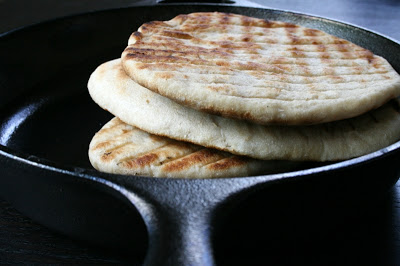
They’re chewy, they’re hot off the grill, and their pockets can be filled with everything from scrambled eggs to falafel. Pitas are a versatile staple to have around the house, and it felt very satisfying to make at home what we usually just grab at the store. The original recipe suggested placing a cast iron skillet on the grill over indirect heat and cooking the pitas that way, but we found that throwing them directly on the grill imparted a delicious flavor, left those appealing grill marks that lets everyone know that yes, you grilled your pitas, and allowed us to cook more at a time. We think it was the right decision (per advice from Bridge of The Way the Cookie Crumbles).

Grilled Pita Bread

(Slightly adapted from the June/July 2010 issue of Fine Cooking – Makes 10 pitas)

1 TBS. honey
2 tsp. active dry yeast
3 1/2 cups unbleached all-purpose flour; more as needed
1/2 cup whole-wheat flour
1 1/2 tsp. kosher salt
2 TBS. olive oil; more for the bowl and baking pans

  • In a small bowl, mix the honey with 1/2 cup lukewarm water and stir in the yeast. Let sit until the yeast has started foaming, 2-3 minutes.
  • Put both flours and the salt in the bowl of a stand mixer fitted with a dough hook (alternatively, you can use a hand-mixer that has a dough attachment – we don’t have a stand mixer and this worked fine). With the mixer running on low speed, mix in the olive oil until fully incorporated, about 2 minutes.
  • Add the yeast mixture and 1 cup lukewarm water and mix until fully incorporated, 2-3 minutes more. Raise the speed to medium and knead dough until it starts to come away from the sides of the bowl and forms a ball that is smooth, elastic, and no longer sticky, 4-5 minutes. If the dough seems too wet and sticky, add more flour 1 tsp. at a time.
  • Raise the speed to medium high and continue kneading for another 5 minutes.
  • Oil a medium bowl and transfer the dough to the bowl. Roll to coat the dough with the oil. Cover with plastic wrap and let rise in a warm place until doubled in size, about 1 hour.
  • Turn the dough onto a lightly floured surface and knead two or three times to remove any air bubbles. Form into a log and divide it evenly into 10 pieces. Form each piece into a ball and then roll into disks about 1/4 inch thick and 6 inches in diameter. Lightly oil two rimmed baking sheets, and place the disks on the baking sheets. Cover with plastic wrap, and let rise until just doubled in thickness, 30 to 45 minutes.
  • Prepare a charcoal fire with indirect heat by placing the coals to one side of the grill. Place the pitas directly on the grill (over the “cool zone” – not directly over the coals) for 2-3 minutes. Flip and cook another 2-3 minutes until cooked through. Depending on the heat of your coals, the time may be shorter or longer. Enjoy while hot!


Looking for a new idea to use homemade pitas? This is what we came up with the evening we made ours. Instead of making use of their pockets, lay them flat, spread a thin layer of goat cheese (like a fromage blanc from Harley Farms), scatter a handful of caramelized onions, and season with salt and cracked black pepper. Place the pitas back on the grill (covered) for a few minutes to warm the cheese and onions, and then top with a handful of fresh, peppery arugula and finish with a drizzle of balsamic. You’ll love the flavor combination. I made a simple fruit salad to go alongside these “pita pizzas.” I tossed freshly cut watermelon, peaches, strawberries, and plums with fresh lime juice and chopped mint. It tasted like summer!


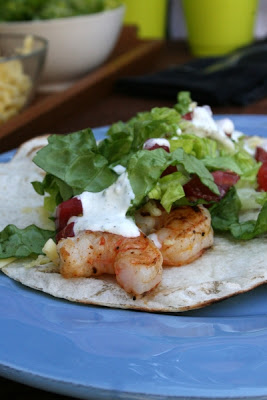
It’s recipe swap time again! This week’s theme was Mexican. Both of us have been fortunate enough to grow up in California where we have eaten some of the best Mexican food outside of Mexico, something we missed greatly while we were in Japan, where there wasn’t an enchilada or a torta in sight (nor was there knowledge of either of those things). This recipe was a little different, so I can’t compare it to the tacos I ate at a little stand down in San Diego or Ensenada, but if you put it in a different category, perhaps Tex-Mex or American-Mexican, it’s a meal that definitely delivers on flavor, from the charcoal flavor of the grilled shrimp to the kick of Jalapeño in the zesty ranch sauce.

Ranch isn’t usually a staple in our house, so I was actually excited to have an excuse to buy the seasoning mix from the store and mix it into sour cream. When I added the grilled jalapeño and whirled everything up in a food processor, I decided this would be the perfect dip for potato chips (I may or may not have tried this while Dustin was grilling the shrimp). Next time, I would up the seasoning in the shrimp marinade – definitely more salt and more chili powder/cayenne, and maybe even add something sweet like honey or agave nectar to balance the flavors, but over all, this is a great meal to enjoy in your backyard on a warm evening with a glass of dry white wine. And I’m telling you, that Jalapeño-Ranch sauce just calls out for potato chips!


Grilled Shrimp Tacos with Jalapeño-Ranch Sauce

(From Sarah of A Taste of Home Cooking)

1 lb shrimp, peeled and deveined (we used small prawns)
Olive oil
Juice of 1 lime
Chopped garlic
Chili powder or cayenne pepper (or both! We also recommend adding salt & pepper to the marinade)
1 jalapeno
1 packet ranch dressing mix (we used what was labeled “ranch dip seasoning”)
1 cup sour cream
Flour tortillas
Shredded lettuce
Diced tomatoes
Shredded Monterey Jack cheese 
Your favorite hot sauce (we used Cholula)

  • Prepare a charcoal grill.
  • Combine shrimp, olive oil, lime juice, garlic and chili/cayenne in a bowl. Marinate shrimp for up to 30 minutes. Lightly oil the jalapeno and grill until nice and charred on the outside, about 5 minutes. Let cool slightly, then discard the stem and cut in half lengthwise. Discard the seeds.
  • Meanwhile, combine the seeded jalapeno with the ranch mix and the sour cream in a food processor and process until smooth. Transfer sauce to a small bowl and refrigerate until use. Cook the shrimp on the grill until they are done, and have nice grill marks. Warm up the tortillas on the grill.
  • To assemble the tacos: spoon some Jalapeño-Ranch sauce on a tortilla, then top with shrimp (after removing the tails!), shredded lettuce, tomatoes and cheese. Drizzle with extra sauce and a few drops of hot sauce.

Older Posts »

Follow

Get every new post delivered to your Inbox.